

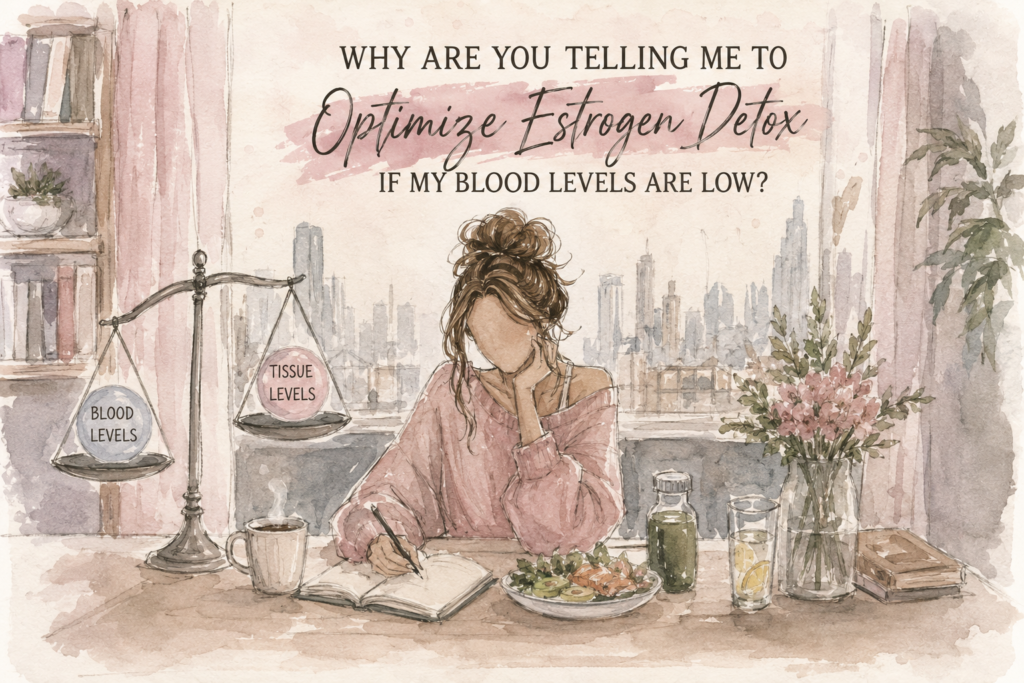
Why Are You Telling Me to Detox Estrogen If My Bloods Are So Low?
If you’ve been told your estrogen is “too low” because you’re in perimenopause or menopause, you might wonder why anyone would suggest supporting estrogen clearance.
After all, if your blood test says your estrogen is low, how could you possibly have too much?
This is where hormone testing gets interesting.
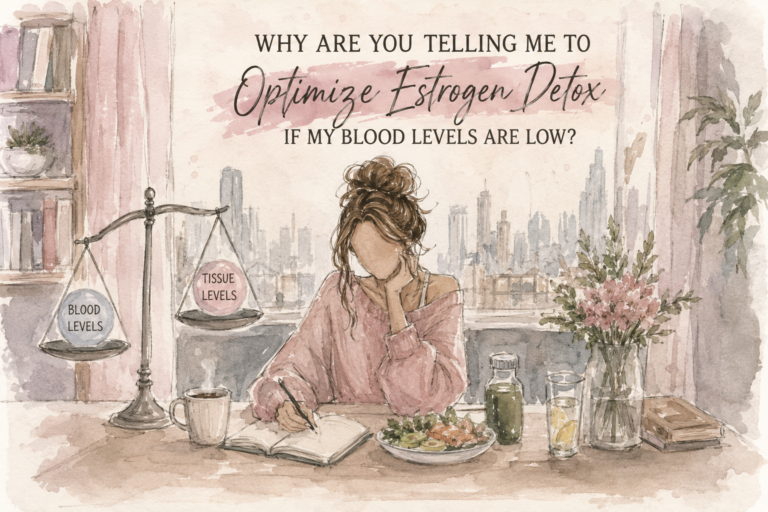
A blood test tells us what is circulating in your bloodstream at that moment. It doesn’t directly tell us what is happening inside every tissue in your body.
And for women in their 40s dealing with low thyroid function, Hashimoto’s, perimenopause, HRT, weight gain, fatigue and hormonal imbalance, that distinction can be important.
Low Estrogen on a Blood Test Doesn’t Tell the Whole Story
As women move through perimenopause, ovarian estrogen production gradually changes.
But estrogen production doesn’t simply switch off.
The body can also produce estrogen in peripheral tissues, including fat tissue, through the conversion of androgen hormones into estrogens. One of the enzymes involved in this process is called aromatase.
So while circulating estrogen may fall, estrogen metabolism and local hormone activity continue.
This is one reason why the number on your blood test doesn’t necessarily explain every symptom you’re experiencing.
What Does Low Thyroid Function Have to Do With Estrogen?
Quite a lot.
Your thyroid influences metabolic rate, temperature regulation, digestion, energy production and many other processes involved in hormone balance.
When thyroid function is poor, you may experience:
- Fatigue
- Cold hands and feet
- Low body temperature
- Constipation
- Brain fog
- Weight gain
- Low mood
- Poor sleep
And many women experience these symptoms years before menopause begins.
Then perimenopause arrives, ovarian hormone production changes, and suddenly everything becomes much harder to manage.
Did Your Hormonal Problems Actually Start With Your Thyroid?
This is one of the questions I think we need to ask more often.
You may have spent years feeling tired, cold, constipated and unable to lose weight.
Then your periods become heavier or irregular. PMS gets worse. Sleep deteriorates. Weight starts moving in the wrong direction.
Eventually you’re told the problem is your hormones.
But what if the metabolic problem came first?
What if declining ovarian hormones simply exposed a problem that had already been developing for years?
This is why I don’t like looking at estrogen, progesterone or thyroid hormone in isolation.
The hormonal system is a system.
Why HRT Can Make You Feel Better
Let’s be clear about this.
HRT can be an extremely effective treatment for many women experiencing perimenopause and menopause symptoms.
It can help with symptoms including hot flushes, night sweats, sleep problems, low mood and vaginal symptoms, and it can provide benefits for bone health.
So if HRT has made you feel better, that doesn’t mean it was the wrong thing to do.
But I would still ask:
Why did your hormonal system become so difficult to manage in the first place?
HRT replaces hormones that fall during menopause. It doesn’t automatically correct low thyroid function, poor metabolic function, inadequate nutrition or digestive problems that may also be contributing to your symptoms.
This doesn’t mean stopping HRT. Decisions about prescribed hormones should always be made with your GP or menopause clinician.
It means looking at what else may be going on underneath the symptoms.
What Does “Estrogen Dominance” Actually Mean?
“Estrogen dominance” is widely used in functional and alternative hormone practice, but it isn’t a formal medical diagnosis.
I therefore don’t use it as a label based on one symptom or one blood test.
Instead, I look for a pattern.
Are you experiencing symptoms such as:
- Breast tenderness
- Water retention
- Heavy periods
- PMS
- Bloating
- Changes in body composition
Are these happening alongside low progesterone, poor thyroid function or signs of reduced metabolic function?
And do they fit an estrogen-related pattern better than another explanation?
That’s a much more useful question than simply asking whether your estrogen number is high or low.
Can You Measure Estrogen Inside Your Tissues?
Not routinely.
A standard blood test measures circulating hormones. It does not directly measure estrogen activity inside your breast tissue, fat tissue, brain or other individual organs.
This doesn’t make blood testing useless. Blood tests are extremely valuable when interpreted properly.
But they are only one part of the picture.
What Does Ray Peat Say About Tissue-Bound Estrogen?
Ray Peat argued that blood hormone concentrations don’t necessarily represent hormone activity inside individual tissues.
In his article Tissue-Bound Estrogen in Aging, he discussed the possibility that estrogen could remain biologically important within tissues even when circulating estrogen appeared relatively low.
He also connected this with progesterone, thyroid function, ageing and metabolism.
Take a look at the original article:
Tissue-Bound Estrogen in Aging
Ray Peat
Peat’s argument was that blood hormone concentrations do not necessarily tell us what is happening inside individual tissues.
This is Ray Peat’s interpretation of physiology, not an established clinical method for diagnosing tissue estrogen.
What About the Breastcancer.org Discussion?
There is an interesting discussion on Breastcancer.org where a forum member shared a summary of Peat’s article and the question of why blood tests may not tell us everything about tissue hormone activity.
Take a look at this discussion:
This article may explain why we don’t have blood tests to check our estrogen and many other things
Breastcancer.org Community Discussion
This is a community discussion and not a scientific study, but it provides an accessible discussion of Peat’s tissue-estrogen theory.
What Does the Research Say?
There is research showing relationships between estrogen, body composition and metabolism. But we need to be careful about what those studies actually prove.
Take a look at this study:
Regulation of protein metabolism in middle-aged, premenopausal women: roles of adiposity and estradiol
Toth MJ, Tchernof A, Rosen CJ, Matthews DE, Poehlman ET.
Journal of Clinical Endocrinology & Metabolism. 2000.
This study examined relationships between adiposity, estradiol and protein metabolism in middle-aged premenopausal women.
The study is interesting because it demonstrates that estrogen status is associated with measurable physiological differences in the body.
It does not prove that women with low blood estrogen have excessive estrogen trapped inside their tissues.
But it does reinforce the wider point that estrogen is connected with body composition and metabolism, not simply a number on a laboratory report.
Can We Learn Anything From Symptoms and Body Changes?
I’m not suggesting that you can look at a woman and diagnose her estrogen levels.
You can’t.
But symptoms and physical changes can provide useful clues.
Changes in body composition, water retention, breast tenderness, menstrual patterns, PMS, energy, temperature, digestion and sleep all form part of the wider picture.
They aren’t diagnostic on their own.
But when combined with blood tests and metabolic markers, they can help us ask better questions.
Why Estrogen Clearance Still Matters
If estrogen metabolism appears to be part of the problem, the answer isn’t necessarily an aggressive “detox.”
Your body already has systems for processing hormones and their metabolites.
So rather than trying to flush estrogen out of the body, I focus on supporting the systems that are already designed to process and eliminate it.
This means looking at:
- Thyroid function
- Metabolic rate
- Adequate nutrition
- Protein intake
- Digestive health
- Regular bowel movements
- Blood sugar stability
- Stress and recovery
The goal is to support normal estrogen metabolism, not eliminate estrogen.
What About Progesterone?
Progesterone becomes increasingly important during perimenopause because ovulation can become less predictable.
When ovulation occurs less consistently, progesterone production can become more variable.
Rather than simply asking, “Is my estrogen too high?”, I think it is useful to ask:
Is my body producing enough progesterone for where I am in my cycle and stage of life?
Nutrition cannot guarantee that progesterone will increase and it cannot replace medically indicated progesterone or HRT.
But nutrition can provide the energy, protein, carbohydrates, fats, vitamins and minerals required for normal hormone production and metabolic function.
My Approach: Look at the Woman, Not Just the Blood Test
This is where my approach is different.
I don’t start with a single hormone result and try to make everything fit around it.
I start with you.
I look at your symptoms, history, menstrual cycle, basal metabolic rate, body temperature, pulse and blood tests.
Then I ask:
Do your symptoms actually fit an estrogen-related pattern?
Or could they be better explained by low thyroid function, reduced metabolic rate, stress hormones, nutrition or another issue?
If estrogen metabolism appears to be part of the picture, I use a nutrition-led approach to support normal estrogen clearance and the metabolic foundations required for healthy hormone production.
I also focus on nutrition to support the foundations required for normal progesterone production.
This approach isn’t designed to replace HRT or medical treatment where appropriate. It is about addressing the nutritional and metabolic foundations alongside appropriate medical care.
Why I Measure Basal Metabolic Rate
Metabolic rate gives us another piece of the puzzle.
When metabolism is running slowly, we may also see clues such as low temperature, low energy, constipation, cold extremities and changes in body composition.
I don’t use metabolic rate as a diagnosis on its own.
I combine it with symptoms, temperature, pulse and blood tests to understand the wider metabolic picture.
Does This Sound Like You?
Are you being told your blood tests are normal, but you know something isn’t right?
Have you started HRT and felt better, but still feel that something is missing?
Are you exhausted, cold, constipated and gaining weight despite being told your thyroid is “normal”?
Do you have breast tenderness, bloating, heavy periods or PMS-type symptoms despite low estrogen on your blood test?
Have you tried diets, supplements or detoxes without getting lasting results?
If you answered yes to several of these, it may be time to stop looking at each hormone separately and look at the metabolic picture as a whole.
How I Work With You 1:1
In a 1:1 consultation, I assess your symptoms, basal metabolic rate, temperature, pulse, blood tests, menstrual history and wider hormonal picture.
We work out whether your symptoms actually fit an estrogen-related pattern or whether low thyroid function and reduced metabolic function may be playing a bigger role.
Where appropriate, I use a nutrition-led approach to support normal estrogen clearance, thyroid function and the nutritional foundations required for healthy hormone and progesterone production.
The aim isn’t to chase a perfect hormone number. It’s to understand why your body is producing the symptoms in the first place.
If you’ve spent years being told that everything is “normal” while you know you don’t feel normal, this may be the missing conversation.
If this sounds like you, get in touch to find out more about working with me 1:1.
References and Further Reading
-
Peat R. Tissue-Bound Estrogen in Aging.
Read the original article.
-
Breastcancer.org Community Discussion. This article may explain why we don’t have blood tests to check our estrogen and many other things.
Read the discussion.
-
Toth MJ, Tchernof A, Rosen CJ, Matthews DE, Poehlman ET. Regulation of protein metabolism in middle-aged, premenopausal women: roles of adiposity and estradiol. Journal of Clinical Endocrinology & Metabolism. 2000.
View on PubMed.
-
Carvalho DP et al. Thyroid peroxidase activity is inhibited by amino acids. Brazilian Journal of Medical and Biological Research. 2000.
View on PubMed.
-
NHS. Benefits and risks of hormone replacement therapy.
Read the NHS guidance.
Important: This article is for educational purposes and is not intended to diagnose, treat or replace medical advice. “Estrogen dominance” is not a formal medical diagnosis, and symptoms alone cannot establish tissue estrogen levels. HRT is an established treatment for many perimenopause and menopause symptoms. Decisions about starting, changing or stopping prescribed hormones should be made with an appropriately qualified healthcare professional.