

Thyroid–Gut–Liver Axis: Why You Still Feel Hypothyroid Despite Normal Tests
You eat clean.
You exercise.
You take your supplements.
You may have cut out gluten, reduced sugar, tried different diets, bought the expensive vitamins and become far more disciplined with your health than most people around you.
And yet you still do not feel better.
You may still feel cold. Bloated. Constipated. Tired after meals. Puffy in the morning. Unable to lose weight without extreme restriction. Your hair may feel thinner, your cycle may have changed, your energy may disappear halfway through the afternoon and you may constantly feel as though your body is working against you.
And perhaps the most frustrating part is that your thyroid blood tests have come back “normal.”
If you have hypothyroid symptoms despite normal thyroid tests, it may be worth looking beyond the thyroid gland itself.
The thyroid is only one part of a much larger metabolic system.
Your thyroid, gut and liver are constantly communicating with one another, influencing thyroid hormone activation, energy production, digestion, hormone clearance and inflammatory signalling.
This interconnected relationship is sometimes described as the thyroid–gut–liver axis, alongside the better-known hypothalamic–pituitary–thyroid (HPT) axis.
For the woman who feels as though she has already tried everything, this distinction can matter.
Because sometimes the question is not simply:
“Is my thyroid producing enough hormone?”
The better question may be:
“Is my body actually able to activate, use and respond to that thyroid hormone effectively?”
How the Liver Affects Thyroid Function and T4-to-T3 Conversion
Your thyroid gland releases predominantly T4, or thyroxine.
But T4 is not the end of the story.
Much of it must be converted into the more metabolically active thyroid hormone T3, and a significant amount of this conversion happens outside the thyroid itself, particularly in tissues such as the liver and kidneys.
This is why liver health and thyroid function are closely connected.
You can potentially produce adequate thyroid hormone while still experiencing problems further downstream with thyroid hormone metabolism.
Your nutritional status, calorie intake, inflammation and physiological stress can all influence this process.
Periods of under-eating, illness, inflammation, chronic stress or inadequate nutrition can reduce peripheral T4-to-T3 conversion and are associated with the pattern sometimes described as low-T3 syndrome.
Chris Kresser – Low T3 Syndrome
This is particularly relevant for women because many of us have spent years being told that eating less is always healthier.
So you reduce your calories.
Then you reduce your carbohydrates.
Then you exercise more.
Then you fast for longer.
And when your energy falls, you assume you simply need to become even more disciplined.
But your body does not necessarily interpret this as “healthy.”
It may interpret it as scarcity.
Ray Peat placed particular emphasis on the liver’s ability to maintain glycogen, the stored form of carbohydrate.
His basic argument was:
Adequate carbohydrate → better liver glycogen → lower stress burden → stronger metabolic function → better thyroid hormone activation
When liver glycogen is repeatedly depleted, the body can rely more heavily on stress hormones such as adrenaline and cortisol to maintain blood glucose.
You might experience this as being tired but wired.
You are exhausted but struggle to relax.
You wake during the night.
You rely on coffee.
You become shaky, irritable or anxious when you miss a meal.
You may even get a strange burst of energy late at night despite feeling exhausted throughout the day.
In this situation, simply “eating cleaner” may not solve the problem.
Sometimes the body needs to feel better fuelled, not more restricted.
Ray Peat discussion on thyroid, temperature, pulse and TSH
How Gut Health Can Affect Hypothyroidism
The digestive system is highly dependent on metabolic energy.
When thyroid activity is reduced, intestinal movement can slow.
This helps explain why constipation, bloating and sluggish digestion are common symptoms associated with hypothyroidism.
And this can create another frustrating situation.
You can be eating an incredibly “healthy” diet filled with vegetables, salads, seeds, nuts and high-fibre foods while feeling progressively more bloated.
That does not necessarily mean those foods are inherently unhealthy.
It may mean your digestive system is currently struggling to handle the amount or type of food you are asking it to process.
When food moves through the intestine more slowly, the microbial environment can also change.
Slower intestinal transit may encourage greater fermentation and, in some circumstances, bacterial overgrowth.
One bacterial compound particularly relevant to the gut–thyroid connection is lipopolysaccharide (LPS), commonly called endotoxin.
LPS is produced by gram-negative bacteria.
When the intestinal barrier becomes impaired, larger amounts of bacterial products may enter circulation and contribute to inflammatory signalling throughout the body.
Research increasingly connects intestinal permeability, microbial products and inflammation with wider metabolic and liver dysfunction.
Review on gut-derived endotoxin and metabolic disease
Ray Peat placed enormous importance on this gut-derived inflammatory burden.
His view was that when digestion becomes sluggish, the intestine can become a continuing source of metabolic stress for the rest of the body.
And directly downstream from the gut sits the liver.
The Gut–Liver Connection
Much of the blood leaving your digestive tract travels directly to your liver through the portal circulation.
This means your liver is constantly processing substances absorbed from your gut, including:
- nutrients
- hormones
- bacterial products
- metabolic waste
- inflammatory compounds
When digestion is functioning well, this relationship is highly efficient.
But when gut motility slows and intestinal permeability or bacterial burden increases, the liver may have more metabolic and inflammatory stress to manage.
At the same time, your liver is already involved in an enormous number of functions, including:
- thyroid hormone metabolism
- glycogen storage
- blood glucose regulation
- bile production
- steroid hormone metabolism
- processing and eliminating hormones such as estrogen
This is one reason I do not think it always makes sense to look at thyroid symptoms, digestive issues, blood sugar and female hormones as completely separate problems.
They can overlap as parts of the same metabolic picture.
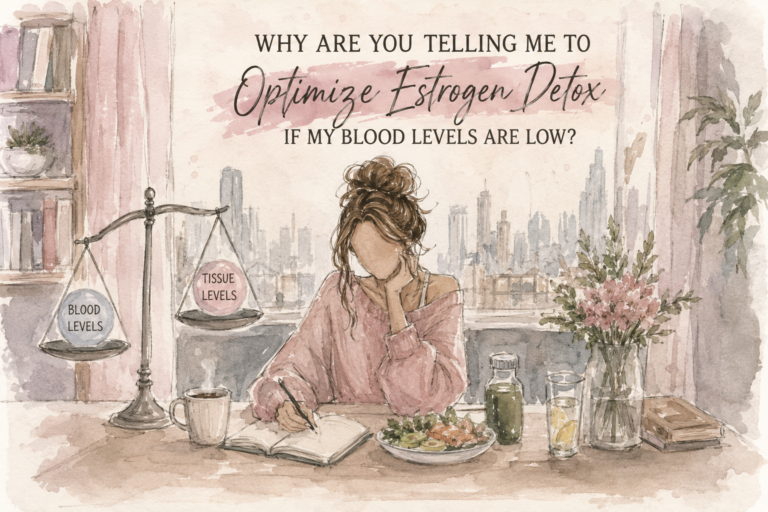
Estrogen, the Gut and the Liver
The liver also plays an important role in processing estrogen so that it can eventually be eliminated from the body.
Some estrogen metabolites are excreted through bile and enter the intestine.
But they do not necessarily leave the body immediately.
Certain intestinal bacteria produce enzymes capable of deconjugating estrogen metabolites, which can allow some estrogen to be reabsorbed into circulation.
This group of estrogen-modifying gut bacteria is sometimes referred to as the estrobolome.
So if bowel movements are infrequent, digestion is sluggish or the gut microbial environment has changed, the way estrogen is eliminated and recycled may also change.
This does not mean every woman with hypothyroidism automatically has “estrogen dominance.”
But it does help explain why gut health, liver function, estrogen metabolism and thyroid function can intersect.
If you are experiencing symptoms such as:
- heavier or more uncomfortable periods
- breast tenderness
- bloating
- constipation
- fluid retention
- worsening PMS
- sluggish digestion
- fatigue
it may be useful to think about the wider metabolic environment instead of trying to address every symptom independently.
The Thyroid–Gut–Liver Feedback Loop
For many women, the pattern may look something like this:
Lower thyroid activity
↓
Lower metabolic rate and slower digestion
↓
Constipation, fermentation and greater intestinal stress
↓
More gut-derived inflammatory burden reaching the liver
↓
Greater demand on liver metabolism and hormone clearance
↓
Less efficient thyroid hormone metabolism
↓
Further reduction in metabolic function
And then, because you feel worse, you try harder.
You restrict more food.
You add another supplement.
You increase your workouts.
You remove another food group.
You tell yourself you need more discipline.
But sometimes the answer is not to push the body harder.
Sometimes it is to understand why the body has slowed down in the first place.
A Natural Approach to Supporting Thyroid, Gut and Liver Function
I am not primarily about forcing the thyroid gland to work harder.
I am about creating an environment in which metabolism could function more efficiently.
The two main goals were:
reduce unnecessary intestinal stress and adequately fuel the liver.
The Raw Carrot Salad
The daily raw carrot salad, typically made with grated carrot, vinegar, salt and a small amount of coconut oil.
The particular fibre structure of raw carrot could help improve the intestinal environment and potentially reduce the recirculation of bacterial products and estrogen.
I do not think of the raw carrot salad as a magical detox.
I think of it as one simple dietary strategy aimed at supporting the gut.
And for a woman who already owns a cupboard full of supplements, there is something appealing about that simplicity.
Supporting your health does not always have to mean adding another expensive bottle of capsules.
Eating Enough Carbohydrates
This is one area where my approach differs strongly from many modern diet trends.
I do not believe that chronically restricting carbohydrates was necessarily beneficial for someone already showing signs of a low metabolic state.
I recommend easily digested carbohydrate sources such as:
- ripe fruit
- orange juice
- honey
- well-tolerated starches
- other easily digested carbohydrate foods
The purpose is not simply to “eat sugar.”
The idea was to provide sufficient glucose to support liver glycogen, stable energy production and a lower reliance on stress hormones.
For the woman who has spent years being afraid of carbohydrates, this can feel completely backwards.
But if you are cold, constipated, exhausted, sleeping badly, exercising intensely and relying on caffeine while eating very little carbohydrate, it may be worth questioning whether further restriction is actually helping your metabolism.
Adequate Protein and Amino Acids
This is not a carbohydrate-only approach.
The liver also depends on adequate protein and amino acids to carry out its many metabolic functions.
Normal hormone metabolism, enzyme production, tissue repair and numerous liver pathways all require amino acids.
So when I think about supporting thyroid metabolism, I am not looking for one magical macronutrient.
I am asking whether the body is receiving enough total energy, carbohydrate, protein and micronutrients to function well.
When the “Healthiest” Diet Is Not Helping
This is an important point.
A diet can look perfect on paper while still not working well for your body.
The enormous salad.
The handfuls of nuts and seeds.
The fasting window.
The intense gym session.
The low calories.
The green smoothie.
The supplements.
None of these things individually tells us whether your metabolism is thriving.
Your symptoms still matter.
Your digestion matters.
Your energy matters.
Your body temperature matters.
Your menstrual cycle matters.
Your sleep matters.
And how you actually feel matters.
Peat was also highly critical of excessive polyunsaturated fatty acid (PUFA) intake, particularly from seed oils.
Some of his stronger claims about PUFA, estrogen and thyroid suppression remain debated, so I would distinguish those ideas from more established physiology.
But the broader principle is useful:
something being labelled “healthy” does not automatically mean it is helping your individual metabolic state.
You May Not Need to Try Harder
If you have already spent years trying to be the healthiest woman in the room, I do not want the takeaway from this article to be that you need another impossible protocol.
The point is almost the opposite.
If your body remains cold, tired, constipated, hormonally disrupted or metabolically resistant despite enormous effort, it may be worth asking whether your current routine is genuinely supporting energy production.
Instead of asking:
“What else can I remove?”
you may get further by asking:
“What does my body need in order to function properly again?”
That could mean:
- improving digestion
- eating enough
- restoring carbohydrate tolerance
- supporting regular bowel movements
- getting sufficient protein
- reducing unnecessary exercise stress
- improving sleep
- identifying nutritional deficiencies
- investigating thyroid and other medical causes properly with a qualified clinician
The model I find most useful is:
Fuel the liver → support thyroid hormone activation → maintain healthy gut motility → reduce unnecessary inflammatory burden → support overall metabolic function
Because your thyroid does not exist in isolation.
And if you have tried everything and still do not feel like yourself, the answer may not be another supplement, another restriction or another harder workout.
It may be time to look at the whole thyroid–gut–liver axis.
Frequently Asked Questions
Can gut health affect thyroid function?
Yes, there are several ways gut health and thyroid function can interact. Thyroid hormones influence intestinal motility, while the gut microbiome, intestinal barrier and gut-derived inflammatory compounds can influence systemic metabolism. Slower digestion is also common in hypothyroidism.
Can liver problems affect thyroid hormone conversion?
The liver is one of several important tissues involved in converting T4 into the more metabolically active hormone T3. Nutritional status, inflammation, illness and metabolic stress can all influence this conversion.
Why do I feel hypothyroid when my thyroid blood tests are normal?
Symptoms such as fatigue, cold intolerance, constipation, hair changes and low energy can have many possible causes. Standard thyroid blood tests are important, but they are only part of the wider clinical picture. Thyroid hormone metabolism, nutrition, iron status, stress, sleep, liver health, medications and other medical conditions can also influence how you feel.
Can constipation affect estrogen levels?
The gut participates in the elimination and recycling of estrogen metabolites. Certain intestinal bacteria can deconjugate estrogen compounds, allowing some to be reabsorbed. This is one reason bowel function and the gut microbiome may influence estrogen metabolism.
What is the thyroid–gut–liver axis?
The thyroid–gut–liver axis describes the interconnected relationship between thyroid hormone metabolism, liver function and the digestive system. Thyroid hormones influence metabolism and gut motility, the liver helps activate and process hormones, and the gut can influence inflammatory and hormonal signals reaching the liver.